How the shift from purposeful design to disposable distraction has left us empty
I don’t think we talk enough about how modern life feels.
Not in terms of productivity or features or screen time—but in terms of fulfillment. We’re surrounded by more tools, toys, and technology than at any point in history. But when you step back, when you really look at the systems we’ve built and the stuff we fill our lives with—does any of it feel like it was made to last?
More importantly—does it feel like any of it was made to matter?
Because I don’t think it does.
From Purpose to Profit
There was a time when we built things to solve problems.
To make life easier, safer, or more joyful.
We designed with purpose—and it showed.
You could feel it in the way things were made. A hand tool that lasted decades. A cast iron stove that heated generations. A car that was simple enough for the average person to maintain, but tough enough to outlive them. You look at something like the Model T—you could bury it for 10 years, dig it up, and it would still run.
Today?
We build for speed.
For margin.
For market share and artificial upgrades.
Somewhere along the way, the purpose shifted from making something good… to making something that sells. And when that became the dominant goal, we started asking the wrong questions entirely.
Designed to Fail, Packaged to Impress
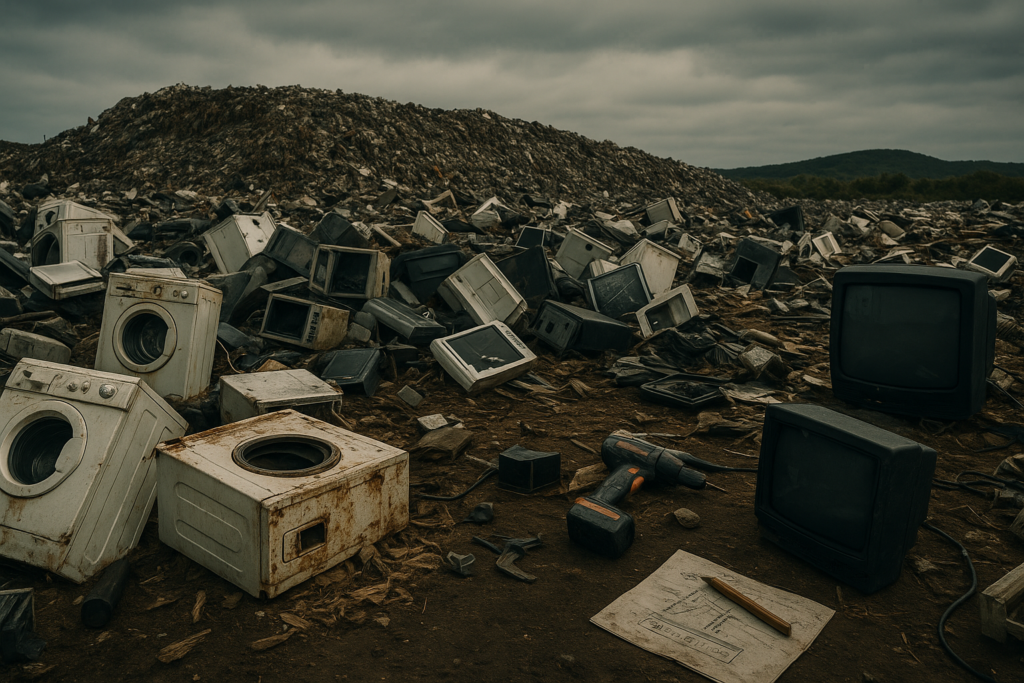
Take a basic appliance—say, your washing machine.
One circuit board connection goes bad, and suddenly, the whole thing is toast.
The repair tech shrugs and says, “It’s cheaper to just buy a new one.”
Think about that.
We throw out a machine where 98% of it still works, because the system was never meant to be maintained—it was meant to be replaced. It wasn’t designed with love. It wasn’t built for repair. It was built for revenue.
And that model? It’s not a glitch.
It’s a feature.
It’s called planned obsolescence, and it’s quietly shaped everything around us—from your phone to your fridge to your car. Products aren’t created to solve a problem anymore. They’re created to keep you on the hook.
When Everything Is “Smarter,” But Nothing Feels Better
Cars are one of the clearest examples of this shift.
They’ve changed a lot in appearance. The dashboard’s digital, the software’s bloated, and the ads all promise a “next-gen driving experience.”
But ask yourself—what real-world problem are they solving?
- They’re not drastically more fuel-efficient.
- They’re not easier to maintain. (In fact, you now need a computer to diagnose half the issues.)
- They don’t last longer, and they certainly don’t create a deeper connection between driver and machine.
So what’s really changed?
We’ve added layers of complexity—because complexity sells.
We’ve traded mechanical simplicity for digital dependence.
We’ve made ownership more fragile, more expensive, and less human.
And deep down, we know it.
Because the more “advanced” our stuff gets, the more helpless we feel when it breaks.
The Real Loss Isn’t Functional—It’s Emotional
When you can’t fix the thing you own…
When it’s designed to be thrown away instead of repaired…
When you’re nudged to upgrade instead of maintain…
You start to feel disconnected from the world around you.
There’s no pride in products you’re expected to toss.
There’s no meaning in tools that are meant to be temporary.
There’s no joy in systems that require you to surrender control to someone else’s ecosystem.
And after a while, that kind of life wears on you.
We feel ungrounded, overstimulated, always chasing something newer—but never feeling like we’ve arrived. It’s like we’re constantly being offered solutions to problems we didn’t have… while the things that really matter—durability, agency, purpose—are nowhere in sight.
The Pride of Building for Someone Else’s Good
There’s something powerful that happens when we build with the end user’s well-being as our guiding light.
When we ask not, “How do I make more?”
But, “How do I make this better—for them?”
When the focus shifts from what I can extract to what I can contribute, everything changes:
- The design gets simpler.
- The function gets sharper.
- The pride goes deeper.
You can feel it in the work.
The joints are tighter. The materials are chosen with care. The systems make sense.
Not because it was the cheapest way—but because it was the right way.
And here’s the thing no spreadsheet can measure:
That kind of work fills you.
It feels good to build something solid.
But it feels soul-satisfying to know someone’s life will be better because of what you made.
We were never meant to build only for profit.
We were meant to build for each other.
And in doing so, we build ourselves.
Maybe the Answer Isn’t More. Maybe It’s Better.
Maybe we don’t need faster upgrades, smarter tech, or more convenience.
Maybe what we really need is:
- Slower cycles
- More time between replacements
- Systems that reward care and patience, not speed and scale
Maybe we need to remember what it means to tend to things—to maintain, repair, and value them. Not just physically, but emotionally.
Because when we build for longevity, we start living that way too.
Closing Reflection: Rebuilding What We Forgot
I don’t have all the answers.
But I know I’m tired of living in a world where things are made to break, where pride in craftsmanship is rare, and where nothing seems to be built with soul anymore.
I want to build things that matter again.
I want to live in a way that honors what I’ve built.
And I want to help others do the same.
What would change if we all started building with love, simplicity, and permanence in mind?
Maybe not everything.
But maybe—just maybe—it’s enough to change the way the world feels again.
Leave a Reply