
What if the thing that makes you lose your cool with your kids is actually the thing that broke you as a kid?
The Day I Stopped Asking Why
Last week, my daughter asked me when we were going to the pool for the fourth time, and I exploded. Not because she was being unreasonable—but because her frustration touched the same raw nerve that got wired in a middle school math class thirty-seven years ago.
But to understand why a simple question lit my fuse like dynamite, we need to go back to where it all started.
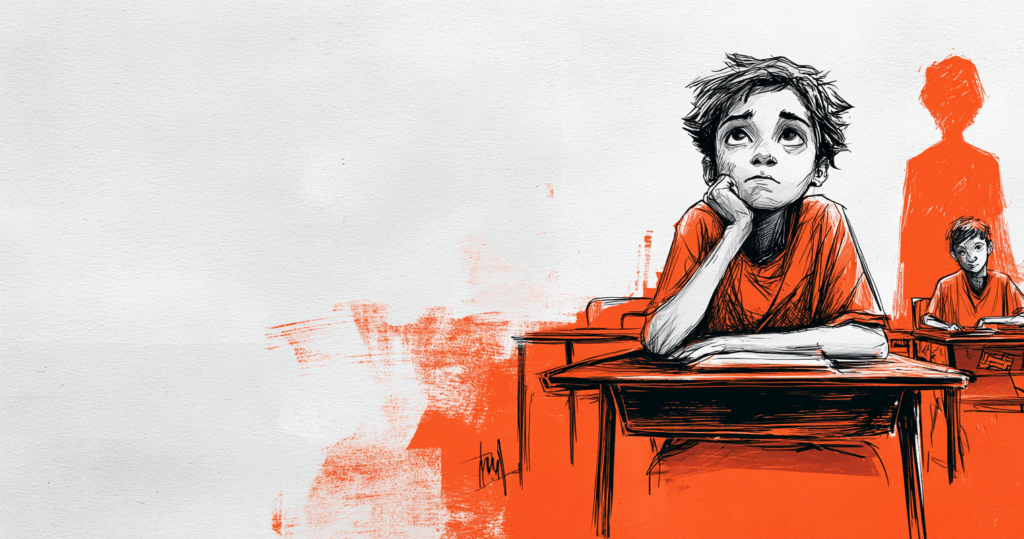
Middle school. Algebra. Mr. Peterson’s classroom with the motivational posters that felt more like threats. I’m sitting there with my ADHD brain firing in seventeen directions while he explains… something.
The words hit my ears but bounce off like tennis balls against a wall—my auditory processing disorder turning clear instructions into Charlie Brown’s teacher.
So I raise my hand.
“Can you explain that again?”
He does, with a slight edge. But my dyslexic brain is still trying to decode the numbers on the board while processing his words, and now I’m further behind.
Hand up again. “I don’t understand the why—”
Eye roll. The universal teacher signal for this kid again.
Third question. The look. You know the one—the “how are you not getting this?” look that makes you want to shrink into your plastic chair.
Fourth question. “Go to the office.”
I remember the walk down that hallway, fluorescent lights buzzing overhead, trying to figure out what I’d done wrong. I’d asked questions. I’d tried to understand. And somehow, that was the problem.
That was the day I learned: curiosity plus confusion equals punishment. So I stopped asking.
The Perfect Storm in My Brain
Here’s what I know now: I’ve got the “triple threat” of neurodivergence—severe ADHD, auditory processing disorder, and dyslexia.
It’s like trying to navigate life with a GPS that only speaks Mandarin while driving a stick shift you never learned, through fog.
In practical terms:
- I need to understand the why before the how makes sense.
- I can’t just follow verbal instructions once; I need them repeated, written, or demonstrated.
- I take longer to connect dots—and when you take longer, people assume you’re not trying.
When you ask “why” for the fifth time, they think you’re challenging their authority. You’re not. You’re just trying to understand.
Fast-Forward: The Pool Promise Incident
Last Thursday I was working from home and I’d promised my four kids we’d hit the pool when I was done. And in case you are wondering; working from home for someone with ADHD is like performing surgery while someone randomly honks an air horn.
By 3 PM, my 13-year-old daughter had reached her limit.
“Dad, when are we going?”
Click-click-click on my keyboard. “Soon, honey.”
“Dad, you said after work. It’s after 3.”
My brain, deep in a spreadsheet rabbit hole: “Just need to finish this one thing.”
“DAD. You PROMISED.”
Each interruption yanked the emergency brake on my train of thought. By the fourth time, I could feel it; her frustration bleeding into the room like smoke under a door. And that’s when something ancient surged in my chest, that furnace heat from decades ago.
I exploded. Not because she was being unreasonable, she wasn’t, but because her frustration hit the same nerve Mr. Peterson did all those years ago.
I’m 49 years old, and I still turn into a scared 12-year-old when someone gets frustrated with me.
Why “Just Stay Calm” Doesn’t Work for ND Dads
Every parenting book says the same thing: Stay calm when your kids get emotional. In dad language: Don’t lose it when they push your buttons.
Cool. Great. I’ll just override forty-nine years of neurological wiring and decades of educational trauma. My brain processes emotional regulation like a dial-up modem trying to stream Netflix, but sure—I’ll just stay calm.
For ND dads, when our kids’ emotions spill over, we absorb them…because apparently ADHD comes with emotional sponge features nobody warned us about. Their anger becomes our anger, their panic becomes our panic, and suddenly we’re drowning in their feelings plus our own. Then when we sense their frustration with us specifically; that’s when the historical trauma kicks in. Now we’re 12 years old in math class again, and we’re feeling everything twice.
The standard dad playbook wasn’t written for brains like ours. It assumes our emotional regulation has settings other than “fine” and “nuclear meltdown.”
Breaking the Cycle (Or At Least Denting It)
I’m not here to tell you I’ve cracked the code. I’m still the guy who loses his keys while holding them.
What I’m trying—and failing, and trying again—is to give my kids what I didn’t get:
- Space to be confused without shame.
- Permission to keep asking why.
- Proof that curiosity isn’t a character flaw.
Some days, I nail it. My 8-year-old struggles with reading (and my trauma brain immediately whispers “what if he’s like you?”), but when he asks me to explain the same sentence four times, I do it—even when that chest-furnace starts heating up.
Other days, like Pool Promise Thursday, I fail spectacularly. But here’s the difference: I apologize. “Hey, that wasn’t about you. That was about something that happened to Dad a long time ago, and I’m sorry you caught the shrapnel.”
I’ve even have a mantra for when I feel the furnace doors opening: “I am not the storm, I am the boat riding the storm.” I know—it sounds like something from a motivational poster in a therapist’s office circa 2003. But sometimes it’s enough to create just enough space between feeling and reacting—to remember I’m the adult.
The Fear That Keeps Me Up
My 13-year-old daughter reminds me of myself—the way she needs the whole picture before the parts make sense, how school feels like a foreign language she’s only partially fluent in.
My 8-year-old’s reading struggles take me straight back to parent-teacher conferences, sitting in those tiny chairs, hearing “not applying himself” and feeling eight years old again.
The neurotypical parent worry: Will my kids be okay?
The neurodivergent parent worry: Will my kids be okay, and am I seeing myself in them because they’re actually like me or because I’m projecting my trauma—and if they are like me, how do I help them when I’m still figuring out how to help myself?
One Thing to Try This Week
If you’re a neurodivergent dad reading this while hiding in the bathroom because bedtime has gone full Lord of the Flies, I need you to know something: your triggers make sense. They’re not moral failings. They’re not character flaws. They’re the echoes of every time someone made you feel broken for thinking differently.
This week, try this: Notice one moment—just one—where your reaction might be about then, not now. Maybe it’s when your partner sighs at your questions. Maybe it’s when your kid’s homework frustration mirrors your own childhood struggles. Maybe it’s when someone says “I already told you that” and suddenly you’re eight years old again.
Just notice it. You don’t have to fix it. You don’t have to be perfect. You just have to see it for what it is.
Because here’s what I’m learning, one spectacular failure at a time: We can’t give our kids what we didn’t get if we’re still pretending we didn’t need it in the first place.
Why I’m Pivoting to Neurodivergent Dads
That’s why I’m shifting some of the content of The Focused Fool to include Neurodivergent Dads—to talk about what it’s really like to parent when your brain comes with special features nobody gave you the manual for.
The wins (remembering where I put my keys—once), the faceplants (see: pool meltdown), and the tools that actually work for brains running different software.
We’re not broken. We’re not bad dads. We’re just running different operating systems, and it’s time someone wrote a user manual that actually works for our hardware.
Even if that manual is written by a guy who still can’t help asking ‘why’ for the fifth time.
FAQ
Q: Why can’t ND dads ‘just stay calm’?
A: ND brains often process others’ emotions as their own, making “calm” feel impossible without tools to regulate first.
Q: What should I do instead of trying to be calm?
A: Focus on awareness and small resets — leave the room for 10 seconds, change sensory input, or use a pre-planned phrase.
Q: Is this the same as being bad at parenting?
A: No. It’s about brain wiring, not willpower — the right tools can help you thrive.
The Focused Fool. A Neurodivergent Dad.
Leave a Reply