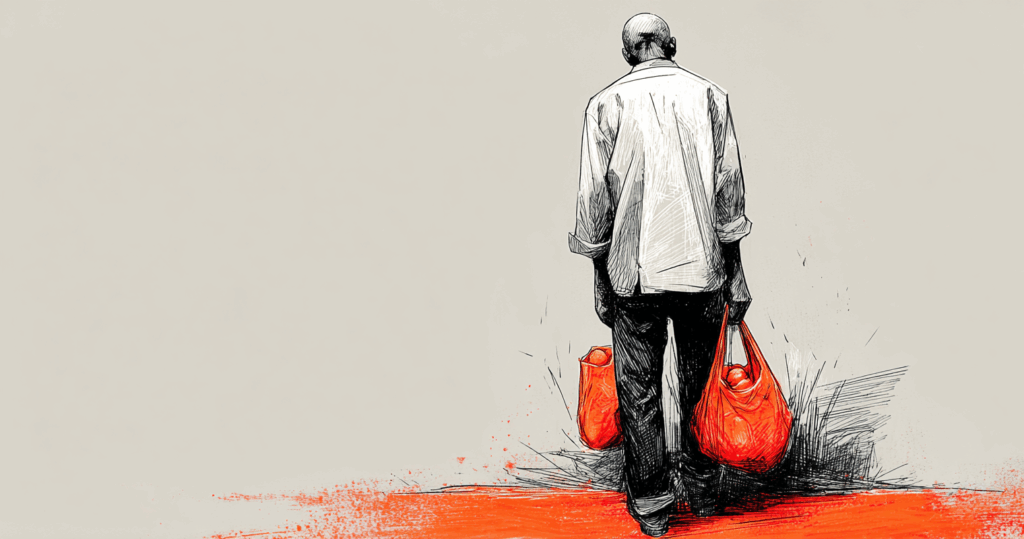
I just got home from work. Nothing was wrong. You weren’t mad. We weren’t fighting. You just needed tomatoes.
“Can you grab tomatoes from the store?”
Simple. Except my brain doesn’t do simple.
“What are we making?” “Tacos.”
The math started immediately. Eight tomatoes. Family of six. That’s too many tomatoes for one meal. The inconsistency lodged in my brain like a splinter.
“That’s too many tomatoes for tacos. Why do we need—” “We’re having people over.”
Now the floodgates opened. My need to understand the “why” took over, each answer spawning three new questions.
“Who’s coming? What time? Are their kids coming? Should I set up yard games? Do I need to mow the lawn first? If the kids are playing outside—”
You closed your eyes. Just for a second. Then came the breath — that specific inhale you do when you’re pulling patience from some emergency reserve that should have been depleted years ago.
I knew that breath. I’d caused that breath a hundred times before.
Here’s the stupid part: I could see myself doing it. There’s a part of my brain that floats above these moments like a horrified spectator, screaming Just stop talking and buy the damn tomatoes. But the need to understand, to map out the entire evening, to optimize; it’s like trying to hold back a sneeze. The pressure builds until it explodes out of me in questions nobody asked for.
“Just… get the tomatoes. Please.”
Your voice had that quality it gets…not angry, just tired. The kind of tired that comes from explaining the same thing different ways for nineteen years.
The Store
I went to get your tomatoes. Of course I did. But even that simple task became an odyssey.
The grocery store, for my brain, is chaos. The fluorescent lights hum at a frequency that makes my teeth itch. Everything screams for attention at equal volume; the sale signs, the floor patterns, the conversation two aisles over about someone’s gallbladder surgery. My brain processes all of it, everything except the tomatoes directly in front of me.
I walked past them three times.
Twenty minutes for tomatoes.
When I got home, you didn’t say anything about the time. You just took the bag, said thanks, and started chopping. The people came over. We ate tacos. Everything was fine.
Except it wasn’t, and we both knew it.
The Pattern
This is our dance, isn’t it? You need something simple. I need a project brief.
You’ll be telling me a story about your day, and I can’t help myself; I interrupt to understand the backstory, the context, the supporting characters. My brain refuses to file the information until I have the complete outline. You just want to tell me about the funny thing your coworker said, but I need to know which coworker, what department they’re in, how long you’ve worked together, what prompted the conversation…
“Forget it,” you say, and the story dies.
Those two words have become your escape hatch. When I can’t find the thing you’ve asked for in the refrigerator (it’s right there, exactly where you said, but the visual noise makes it invisible). When I need three clarifying questions before I can start a simple task. When my help becomes harder than doing it yourself.
“Forget it.”
Two words that mean: I’ll just do it myself. Like always.
The Kitchen Conversation
Three nights ago, we were in the kitchen. I was excited, telling you about my research into neurodivergent fathers, how I’d started writing about it, how I’d finally understood that my brain doesn’t just affect how I learn…it affects how I parent, how I husband, how I exist in our family.
I was explaining how I’m an emotional sponge, absorbing everyone’s feelings until I overflow. How that’s why I yell when the kids get loud, not because I’m angry, but because I can’t process all the emotional input. I thought you’d be relieved. Finally, an explanation. Finally, I understood myself.
You were washing dishes, your back to me. And then you said it:
“You’ve always been great about not using your ND as an excuse. Don’t start now.”
The water kept running, but everything else stopped.
Because you were right. I was doing exactly what I swore I’d never do; turning my diagnosis into a get-out-of-jail-free card. Sorry I interrogated you about tomatoes, that’s just my neurodivergent need for context. Sorry I’m late, time blindness. Sorry I yelled, sensory overload.
Understanding why my brain works this way doesn’t erase the impact. It doesn’t give you back the twenty minutes you waited for tomatoes. It doesn’t unhear the “forget it”s. It doesn’t unfeel the exhaustion of being married to someone who needs a flowchart for everything.
The Truth About My Brain
Here’s what I’ve learned about my wiring, and why it’s not your problem to solve:
The “why” isn’t about you. It’s about my brain’s desperate need to make sense of the world. Every piece of information needs context, needs a place to live in my mental filing system. But you’re not asking me to file information. You’re asking me to buy tomatoes.
The store chaos, the refrigerator blindness, the walking past things in plain sight — my brain takes in everything at equal volume. The important and the irrelevant stream in at the same intensity. But that’s not your fault, and you shouldn’t have to draw me maps to the milk.
The internal monologue, the floating observer who watches me wreck conversations, he’s real. Some days I can listen to him. When I’m centered, when I have energy, I can ask myself: Will this question help? Is it needed? And sometimes I can stop myself.
But “sometimes” isn’t enough when you’re the one living with all the other times.
What This Is Really About
The tomatoes were never about tomatoes. They were about trust.
You asked me to do something simple, trusting I could handle it without turning it into an interrogation. Trusting I could be a partner, not a project. Trusting that after nineteen years, I’d learned when to stop asking why and just help.
Every unnecessary question is me saying: I don’t trust your judgment. I need to verify. I need to optimize. I know better.
But you’re the one who keeps our family running while I’m hyperfocusing on the optimal lawn-mowing pattern. You’re the one who remembers the teacher conferences while I’m researching the history of standardized testing. You’re the one who actually buys the tomatoes while I’m philosophizing about their necessity.
You don’t need me to understand everything. You need me to trust you. To help without interrogating. To be present without processing.
The Promise
I can’t rewire my brain. The “why” will always be there, pressing against the inside of my skull. The store will always be chaos. The observer will always be floating, watching me make the same mistakes.
But I can choose what I do with that wiring.
When you ask for tomatoes, I can notice the “why” rising up and choose not to voice it. Just once, then twice, then enough times that it becomes a new pattern.
When the store overwhelms me, I can make a list, put in earbuds, do whatever it takes to get your tomatoes in less than twenty minutes.
When you’re telling me a story, I can let it unfold without needing the complete backstory. I can trust that the information will make sense eventually, or that maybe, radical thought, it doesn’t need to make sense. Maybe it just needs to be heard.
I’m working on it. Not perfectly, yesterday I caught myself three questions into interrogating you about dinner plans before I stopped. But I stopped. The observer won that round.
The Real Apology
I’m sorry for the thousand tomato incidents. For every time I’ve made you defend a simple request. For every “forget it” I’ve caused. For being the husband who needs a user manual when you just need milk from the store.
I’m sorry for making my brain your problem to manage.
But mostly, I’m sorry it took me this long to understand that explaining my wiring isn’t the same as changing my behavior. That understanding myself isn’t the same as improving myself. That having a reason isn’t the same as having an excuse.
You’ve been patient with my brain for nineteen years. You’ve adapted, adjusted, worked around my wiring without complaint. You’ve become fluent in my chaos.
But you shouldn’t have to be.
So this is my promise: Next time you ask me to get something from the store, I’ll have three questions in my head and zero on my lips. I’ll trust that you know what you need. I’ll trust that tomatoes can just be tomatoes.
The “why” will always be there. But it doesn’t have to be yours to answer anymore.
That’s what I’m working on. One tomato at a time.
The Focused Fool. Growing As Men. Leading As Fathers.
Leave a Reply